Your website is the first place prospects look at. Create a dedicated “Certifications” or “Quality & Compliance” page that displays the certification mark, the standard and version, your certificate number, and a short, benefit-led explanation of what it means for customers (for example: “Our ISO 9001:2015 certified quality management system means consistent delivery and fewer defects on every order”). Link to it from your homepage, footer and “About” page so it is easy to find.
September 30, 2026
Earning ISO certification is a significant achievement. Months of process mapping, internal audits and team effort culminate in independent, third-party confirmation that your organization meets a globally recognized standard. Yet many organizations file the certificate away and miss the opportunity it represents. A certification is not just a compliance milestone, it is one of the most credible marketing assets your business will ever own.
This guide explains how to promote your ISO certification effectively across digital, sales and offline channels, and, just as importantly, how to display the certification mark correctly so your promotion stays compliant. Used well, your certification builds trust, supports tender wins and differentiates you from competitors who cannot make the same claim.
Why your certification is a marketing asset
Buyers increasingly research suppliers before they ever make contact. Independent studies consistently show that the majority of B2B buyers complete much of their evaluation online before speaking to a salesperson, and a visible, verifiable certification is a powerful trust signal during that process. ISO standards such as ISO 9001 (quality management), ISO 14001 (environmental management), and ISO 45001 (occupational health and safety) are recognized worldwide, so the credibility transfers across markets and borders.
Certification reassures customers that your processes are consistent, your risks are managed, and your commitment to quality is independently verified, not self-declared. In competitive tenders, particularly in the public sector and regulated industries, certification is frequently a mandatory prerequisite. Promoting it therefore does two jobs at once: it wins trust with prospective customers and it keeps you eligible for opportunities your competitors may be locked out of.
Know what you can claim before you promote
Effective ISO marketing starts with accuracy. Before you publish a single post, make sure every claim is precise and defensible:
- State the full standard designation. Use “ISO 9001:2015” rather than a vague “ISO certified.” The year identifies the version you were assessed against and signals that you understand the standard.
- Be specific about scope. Your certification applies only to the activities and sites defined in your certificate. Never imply that certification extends beyond the approved scope. For example, if only one of your facilities is certified, you must not use the certification logo to represent the entire group. The logo may only be used in connection with the certified facility.
- Certify the system, not the product. Certificates like ISO 9001 or ISO 45001 confirm that your management system is certified, it does not certify any individual product. This distinction matters legally and is covered in detail in the logo section below.
- Name the certification body. Reference SGS as your certification body if your organization has been certified by SGS. It adds credibility and makes the claim verifiable.
Where and how to promote your certification
Certification delivers the greatest value when it is visible to the people who matter most, your customers, partners and prospects. The following recommendations will help you showcase your certification while ensuring the SGS certification mark is used correctly and in accordance with the applicable guidelines.
A new certification, a recertification or the addition of a new standard are all newsworthy moments. Maximize them:
- Publish a press release to local, trade and industry outlets, framed around customer benefit rather than internal process.
- Post the announcement on LinkedIn and other social channels, tagging the team and explaining what it means for clients.
- Send a customer email or newsletter feature celebrating the milestone and what it guarantees them.
- Add a line to your email signatures and out-of-office replies.
Most customers know certification is good but cannot articulate why. Close that gap with content. Write a blog post or short article explaining how your certified management system benefits them through consistency, traceability, continual improvement or reduced environmental impact. A short video, a customer FAQ (frequently asked questions) or a webinar segment all reinforce the same message and give your sales team material to share.
Certification is often decisive in competitive bids. Make sure it works hard for you in the sales cycle:
- Include the certificate and scope in RFP (request for proposal) and tender responses, especially where ISO compliance is a stated requirement.
- Add a certification slide to your standard sales deck and capability statements.
- Train sales staff to translate the certification into customer outcomes, not jargon.
- Reference it in proposals, quotations and qualification documents.
Physical touchpoints still build credibility such as trade shows, meetings and on site. Display the certification mark on brochures, business cards, vehicle livery, signage, presentation folders and exhibition stands. Each placement is a quiet, repeated reminder that an independent body has verified your compliance with recognized standards.
Remember the product distinction covered below: the mark belongs on company and marketing materials, not on the product itself or its packaging.
Remember: you cannot use the ISO logo
The official ISO logo is a registered trademark and cannot be used by certified organizations on any material, be it digital or offline.
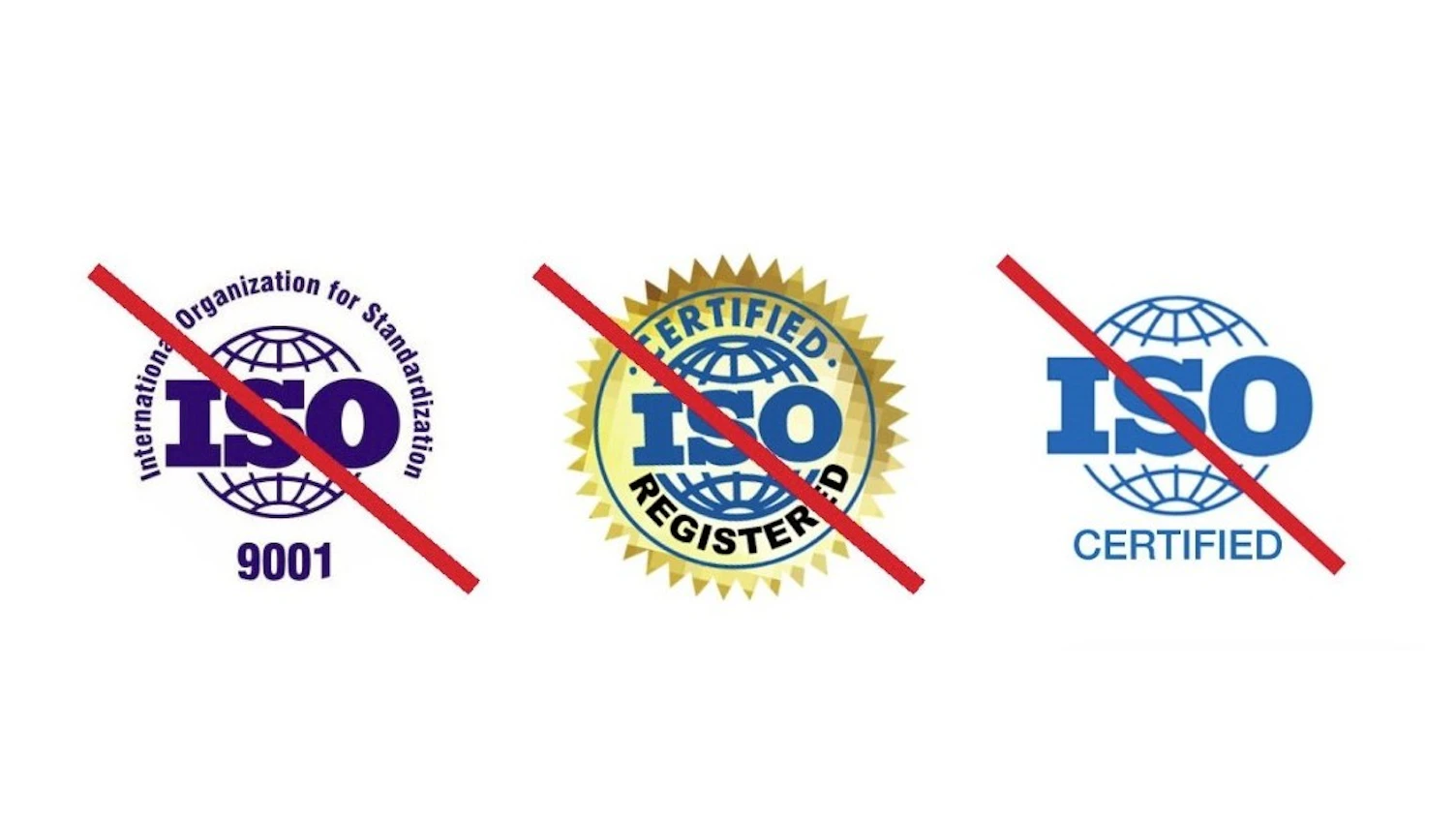
ISO does not issue certifications or certify products, services, or organizations. Its role is to develop and publish international standards. Certification is carried out by independent certification bodies, such as SGS, against those standards.
Use of logos and certification marks
The ISO logo must not be used by certified organizations. However, they can use dedicated “certification marks” provided by their certification body. Although certification marks must not be placed on products or primary product packaging, they may be used on approved company and marketing materials.
Using the certification marks: Do's and Don'ts
A certification mark demonstrates that an organization's management system has been certified by an accredited certification body. The right to use a certification mark is subject to the rules established by the certification body and the applicable accreditation requirements.
For example, if your organization is certified by SGS, the use of the SGS certification mark is governed by the SGS Mark Use Agreement. The certification mark provided by the certification body must be used only as supplied and must not be modified. Following these requirements helps ensure compliant communications and protects the credibility and integrity of the certification. Misuse may result in the suspension or withdrawal of the right to use the certification mark.
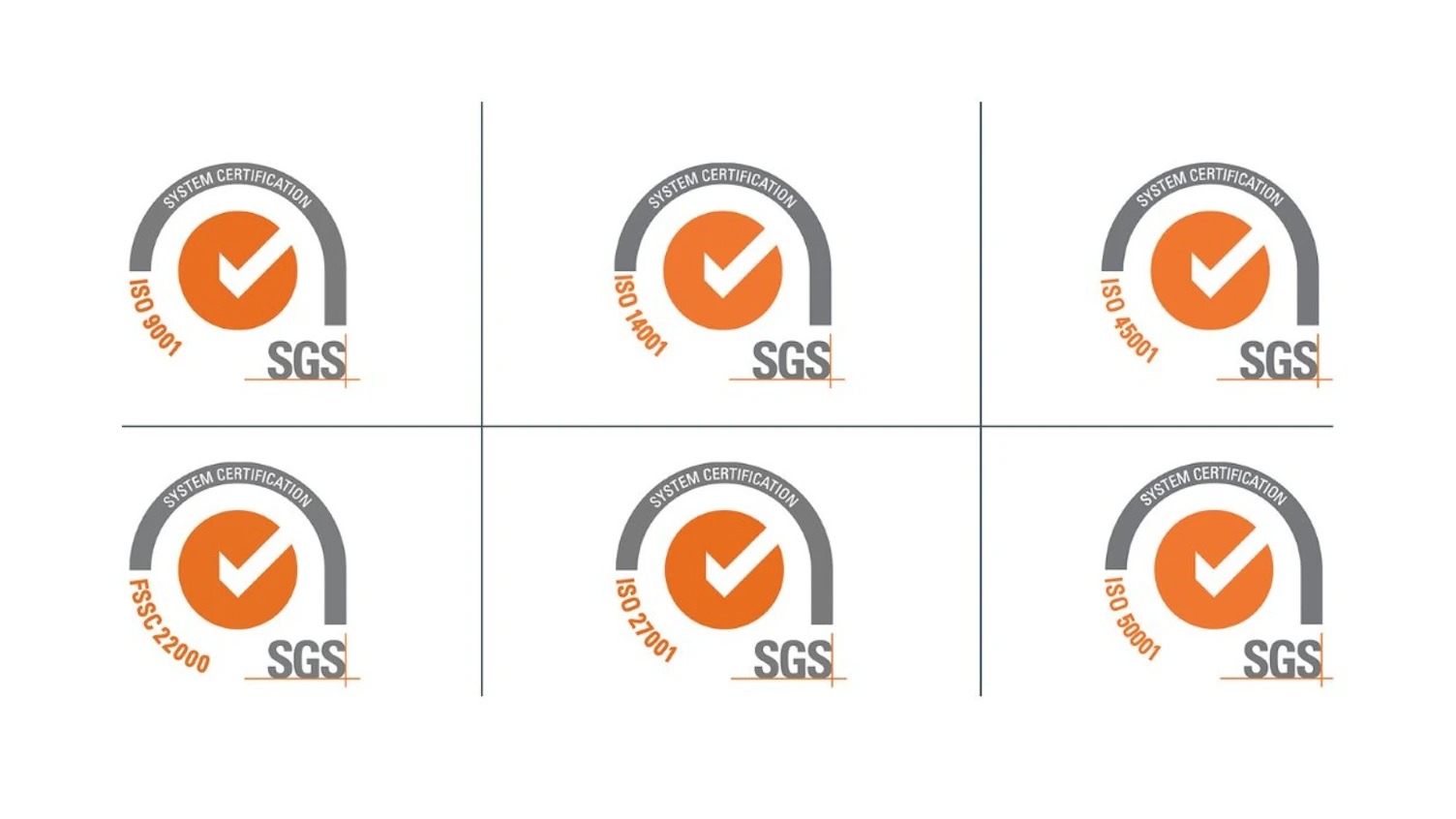
Quick visual reference: use the original mark as supplied.
Never distort, recolor, rotate, pixelate, or place it on a busy background.
Never distort, recolor, rotate, pixelate, or place it on a busy background.
Quick Reference Table
| DO | DON'T |
|
|
The most important rule:
certify the system, not the product
This is where organizations most often slip up. An ISO management-system certificate applies to your organization's management system, not to any individual product, and the certification mark must never be affixed to a product, a product label or product packaging, nor used in any way that could be read as certifying the product itself. Type plates and identification labels count as part of the product, so the mark does not belong there either.
If you want to reference your certified system on packaging or product literature, use a written statement instead of the mark. for example, in case it has been certified by SGS: “[Company name] operates a quality management system certified to ISO 9001:2015 by SGS.” The statement must make clear it refers to your management system, not to the product, process or service.
Best practices for using certification marks and communicating your achievement
Using certification marks correctly and communicating your achievement accurately helps protect the integrity of your certification while building trust with customers and stakeholders. The following best practices will help you promote it with confidence and in line with applicable requirements.
- Use certification marks only in accordance with your certification body's requirements and always use the official artwork provided.
- Never use the ISO logo. ISO develops and publishes standards, but it does not certify organizations. Where permitted, use your certification body's mark instead.
- Use certification marks only on approved corporate and marketing materials. Do not place them on products or primary product packaging in a way that could imply product certification.
- When referring to your certification in product-related communications, use a factual statement instead, such as: "Our Quality Management System is certified to ISO 9001:2015."
- Don’t forget to revise the version of ISO standard in all communication materials when certified against the latest version (for example, when certified against ISO 14001:2026 instead of ISO 14001:2015).
- Ensure all claims accurately reflect the scope of your certification, including the certified management system, activities, and locations.
- Remove certification marks and related claims promptly if your certification expires, is suspended or is withdrawn.
- Always use the original, high-resolution mark supplied by your certification body. Do not modify, stretch, recolor or recreate it.
- Clearly communicate that certification applies to your management system, not to your products or services, unless a separate product certification has been obtained.
Make your certification work for you
ISO certification is proof that your organization is committed to quality, consistency and continual improvement. By promoting it clearly across every channel and displaying the certification mark correctly, you transform a compliance document into a lasting competitive advantage.
If you have any questions or guidance, feel free to contact us.
Stay informed. Subscribe now.
For exclusive insights on management systems, ISO standards and sustainable business growth, subscribe to our monthly email newsletter.

About SGS
SGS is the world’s leading Testing, Inspection and Certification company. We operate a network of over 2,500 laboratories and business facilities across 115 countries, supported by a team of over 100,000 dedicated professionals. With more than 145 years of service excellence, we combine the precision and accuracy that define Swiss companies to help organizations achieve the highest standards of quality, compliance and sustainability.
Our brand promise – when you need to be sure – underscores our commitment to trust, integrity and reliability, enabling businesses to thrive with confidence. We proudly deliver our expert services through the SGS name and a portfolio of trusted specialized brands, including Applied Technical Services, Brightsight, Bluesign and Nutrasource.
SGS is publicly traded on the SIX Swiss Exchange under the ticker symbol SGSN (ISIN CH1256740924, Reuters SGSN.S, Bloomberg SGSN SW).